
Showing posts with label telecentre. Show all posts
Showing posts with label telecentre. Show all posts
2012-02-13
The Unique Challenges of Making Technology Work in Developing Countries | Inveneo.org
Submitted by Inveneo Newsfeed on 26 January 2012 - 7:00am.
Making technology work in the rural and developing world is a process full of unique challenges. This post - The Unique Challenges of Making Technology Work in Developing Countries - by Andris Bjornson, Inveneo's Chief Technology Officer and practicing project engineer, describes his day traveling to bring the Cisco Community Knowledge Center (CKC) in Sekenani, Kenya online with high speed terrestrial broadband Internet.
The condensed timeline, wild game, and bad weather combined to make this a good story ... well worth reading.


2009-01-13
Compendium on Impact Assessment of ICT-for-Development Projects
Billions of dollars thoughout the world are invested each year by the public, NGO and private sectors in information and communication technologies for development (ICT4D) projects such as telecentres, village phone schemes, e-health and e-education projects, e-government kiosks, etc. We all feel that these are good things, and yet we have very little sense of the effect of that investment. I know of some that failed because they were too "top-down". I know of others that were a resounding success (e.g., e-Bario) because they used a community development perspective from the start. But these anecdotes do not satisfy funders or governments. Put simply, there is far too little impact assessment of ICT4D projects.
In part that reflects a lack of political will and motivation. But in part it also reflects a lack of knowledge about how to undertake impact assessment of ICT4D. The "Compendium on Impact Assessment of ICT-for-Development Projects" by Richard Heeks and Alemayehu Molla, IDRC & CRDI, 2008, aims to address that lack of knowledge.
"It presents a set of frameworks that can be used by ICT4D practitioners, policy-makers and consultants to understand the impact of informatics initiatives in developing countries.
The Compendium is arranged into three parts:
• Overview – explains the basis for understanding impact assessment of ICT4D projects, and the different assessment frameworks that can be used.
• Frameworks – summarises a series of impact assessment frameworks, each one drawing from a different perspective.
• Bibliography – a tabular summary of real-world examples of ICT4D impact assessment."
Citation details:
In part that reflects a lack of political will and motivation. But in part it also reflects a lack of knowledge about how to undertake impact assessment of ICT4D. The "Compendium on Impact Assessment of ICT-for-Development Projects" by Richard Heeks and Alemayehu Molla, IDRC & CRDI, 2008, aims to address that lack of knowledge.
"It presents a set of frameworks that can be used by ICT4D practitioners, policy-makers and consultants to understand the impact of informatics initiatives in developing countries.
The Compendium is arranged into three parts:
• Overview – explains the basis for understanding impact assessment of ICT4D projects, and the different assessment frameworks that can be used.
• Frameworks – summarises a series of impact assessment frameworks, each one drawing from a different perspective.
• Bibliography – a tabular summary of real-world examples of ICT4D impact assessment."
Citation details:
Heeks, R. & Molla, A. (2008). Compendium on Impact Assessment of ICT-for-Development Projects. Manchester: IDRC. Retrieved January 09, 2009 from http://idrc-ia-for-ict4d-compendium.doc
2008-10-29
Solar-powered Linux computer networks for remote villages
Original article by Robin 'Roblimo' Miller on November 04, 2008 (7:00:00 PM)
 Scott Johnson of GNUveau Networks has developed a solar-powered Internet "hub" system (running Ubuntu GNU/Linux) that he builds to order in his Daytona Beach, Florida, home.
Here is a video about his solar powered system.
Scott Johnson of GNUveau Networks has developed a solar-powered Internet "hub" system (running Ubuntu GNU/Linux) that he builds to order in his Daytona Beach, Florida, home.Here is a video about his solar powered system.
His objective is to bring computers and the Internet to places that have no connectivity, no phone service, and no electricity. This is no pipe dream. There are real SolarNetOne installations running in Africa right now, providing wireless connectivity and "Internet Cafe" access to hundreds of people. The system uses off-the-shelf hardware that Scott modifies to run on 12V -- and to use a lot less power than the stock versions. As Scott says, in solar-powered computer installations, "The Watt is king."
2008-03-23
Wireless Networking
Today I'm returning to the issue of access and connectivity, because I came across some websites and articles with useful information and ingenious solutions.
Wireless Networking in the Developing World
The goal of the wndw website is to help you get the resources you need to build a wireless network that solves your communication problems.

One of the major resources provided is a free book - Wireless Networking in the Developing World - about designing, implementing, and maintaining low-cost wireless networks. In it you will find information about:
Wireless Wok
A few years ago, a university lecturer in New Zealand developed what he called the Wireless Wok approach. It is very DIY and low cost, but needs a fair bit of technical support

Drive-byWi-fi
United Villages provides villagers in Asia, Africa, and Latin America with a digital identity and access to locally-relevant products and services using a low-cost, store-and-forward "drive-by WiFi" technology. Mobile Access Points (MAPs) are installed on existing vehicles (e.g. buses and motorcycles) and automatically provide access for WiFi-enabled Kiosks along the roads. Whenever a MAP is within range of a real-time wireless Internet connection, it transfers the data from and for those Kiosks. United Villages sells prepaid cards to village Kiosk Operators and local sales agents who resell the cards to users at a profit and provide a human interface for our products and services, which include:
Other Resources
There is a useful summary of resources at the webpage "Resources for low cost wireless networking".
The materials developed as part of the "Capacity building for community wireless connectivity in Africa" initiative which is funded by IDRC and coordinated by APC are available for trainers at: Wireless networking.
The South African CSIR Meraka Institute's Wireless Africa program is dedicated to making low cost networking accessible across the African continent: Wireless Africa.
A DIY Mesh Guide prepared by the Wireless Africa group at the Meraka Institute: Building a Rural Wireless Mesh Network.
Wireless Networking in the Developing World
The goal of the wndw website is to help you get the resources you need to build a wireless network that solves your communication problems.
One of the major resources provided is a free book - Wireless Networking in the Developing World - about designing, implementing, and maintaining low-cost wireless networks. In it you will find information about:
- How to design a wireless network that extends the reach of an existing Internet connection
- Understanding radio waves, antennas, and transmission lines
- Choosing and configuring wireless networking hardware
- Designing a solar energy system to provide power to network devices in remote places
- Securing, monitoring, and maintaining your network
- Implementing an economic model that will sustain your project
Wireless Wok
A few years ago, a university lecturer in New Zealand developed what he called the Wireless Wok approach. It is very DIY and low cost, but needs a fair bit of technical support
Drive-byWi-fi
United Villages provides villagers in Asia, Africa, and Latin America with a digital identity and access to locally-relevant products and services using a low-cost, store-and-forward "drive-by WiFi" technology. Mobile Access Points (MAPs) are installed on existing vehicles (e.g. buses and motorcycles) and automatically provide access for WiFi-enabled Kiosks along the roads. Whenever a MAP is within range of a real-time wireless Internet connection, it transfers the data from and for those Kiosks. United Villages sells prepaid cards to village Kiosk Operators and local sales agents who resell the cards to users at a profit and provide a human interface for our products and services, which include:
- Sending and receiving voicemails, text messages, emails, and faxes;
- Purchasing locally-unavailable products such as medicines, books, and seeds, which are delivered to Kiosks on the MAP-mounted vehicles;
- Accessing value-added services such as job searches, travel bookings, and matrimonials;
- Browsing locally-relevant websites and information caches.
Other Resources
There is a useful summary of resources at the webpage "Resources for low cost wireless networking".
The materials developed as part of the "Capacity building for community wireless connectivity in Africa" initiative which is funded by IDRC and coordinated by APC are available for trainers at: Wireless networking.
The South African CSIR Meraka Institute's Wireless Africa program is dedicated to making low cost networking accessible across the African continent: Wireless Africa.
A DIY Mesh Guide prepared by the Wireless Africa group at the Meraka Institute: Building a Rural Wireless Mesh Network.
2008-03-02
Solar-Powered Wi-Fi
My blog is mainly about the use of the Internet for education and development. Note that I did say "use" not "access". But often in my job I get someone saying, "Oh, but people can't use the Internet for education in village X because they don't have access to it or to electricity". Well today's blog is precisely about how we can get around these problems.
As solar power becomes more affordable, it is possible to bring Wi-Fi to previously inaccessible locations. Here is one success story - Green Wi-Fi.

The mission of Green Wi-Fi is "to help deliver the world's information to people in developing areas seeking knowledge, hope and opportunity in a digitally divided world." It seeks to bridge the last critical mile in Internet access using nothing more than a single broadband connection, rooftops and the sun. Green WiFi has developed a low cost, solar-powered, standardized WiFi access solution that runs out-of-the-box with no systems integration or power requirements.
Self healing network Green WiFi nodes can then be deployed on rooftops to form a self-healing network that hops the source signal over a virtual 802.11b/g grid. Because these nodes require no fixed installation or power tie-ins, they can form an unplanned, mobile grid that can grow or be relocated as needed. Working with other programs Green WiFi aims to complement and extend the power and promise of initiatives such as the UN/MIT One Laptop Per Child (OLPC) project, Intel's World Ahead Program and other NGO efforts dedicated to providing affordable computing capabilities to developing areas.
More about wi-fi .
.
As solar power becomes more affordable, it is possible to bring Wi-Fi to previously inaccessible locations. Here is one success story - Green Wi-Fi.
The mission of Green Wi-Fi is "to help deliver the world's information to people in developing areas seeking knowledge, hope and opportunity in a digitally divided world." It seeks to bridge the last critical mile in Internet access using nothing more than a single broadband connection, rooftops and the sun. Green WiFi has developed a low cost, solar-powered, standardized WiFi access solution that runs out-of-the-box with no systems integration or power requirements.
Self healing network Green WiFi nodes can then be deployed on rooftops to form a self-healing network that hops the source signal over a virtual 802.11b/g grid. Because these nodes require no fixed installation or power tie-ins, they can form an unplanned, mobile grid that can grow or be relocated as needed. Working with other programs Green WiFi aims to complement and extend the power and promise of initiatives such as the UN/MIT One Laptop Per Child (OLPC) project, Intel's World Ahead Program and other NGO efforts dedicated to providing affordable computing capabilities to developing areas.
More about wi-fi
.
2007-11-19
e-Bario: An excellent example of community engagement using ICT
I have seen several successful examples of communities benefitting from ICT over the last few years. Yesterday's post on the "E-Bario Knowledge Fair" reminded me of one that I regard as one of the most successful - the e-Bario project.
The district of Bario comprises a small group of remote Kelabit communities in the highlands of Sarawak in Malaysia. Only about 1000 people out of approximately 5000 Kelabit remain in the highlands, the rest having moved away in pursuit of jobs and education.
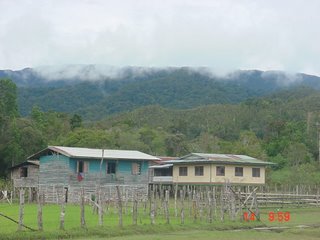 Photograph by Gary Loh Chee Wyai (2006)
The e-Bario project was coordinated by Universiti Malaysia Sarawak and financially supported by the Demonstrator Application Grant Scheme and Canada International Development Research Centre (e-Bario 2004). The project connected the village to the Internet, not only to provide a means for the villagers to communicate with their relatives and others outside Bario, but also "to identify opportunities for such communities to develop socially, culturally and economically from the deployment of the technologies" (Bala et al 2004, p.116).
The researchers realized the importance of engaging and empowering the community, and of placing the emphasis on the people and the process, not the technology. They identified with and learned about life in the village from the community, and the community learned about ICT from the researchers. They adopted a Participatory Action Research (PAR) model, in which community members performed major portions of the research.
In their analysis of the e-Bario project, Bala et al (2004) conclude that a prerequisite for success and sustainability is the use of a collaborative approach in which the community participates fully in all stages and parts of the project. They also suggest that since the information solutions span education, health, commerce, agriculture and culture as well as communications, there is no single agency that carries responsibility or authority for community development by means of ICTs. Instead, a range of agencies needs to be mobilized and coordinated for full benefits to flow to the community (Bala et al 2004, p.124).
Bala, P., Harris, R.W. and Songan, P. (2004) "E Bario project: In search of a methodology to provide access to information communication technologies for rural communities in Malaysia". In Marshall, S., Taylor, W., & Yu, X. (Eds.) (2004) Using Community Informatics to Transform Regions
e-Bario. (2004). e-Bario. Website accessed 15 August 2007 at: http://www.unimas.my/ebario/
Wyai, Gary Loh Chee (2006). Bario: the Land of the Kelabits - my third day. Website accessed 19 August 2007 at: http://ebario.blogspot.com/2006/04/my-third-day-at-bario.html
Subscribe to:
Posts (Atom)