Showing posts with label e-governance. Show all posts

2013-04-22

How Canada is Revolutionizing Digital Governance » blog.howto.gov


The Canadian government is changing how we think of traditional Web management. They built a platform of standards-compliant (HTML5, WCAG and WAI-ARIA), accessible and secure components that its agencies (and even provincial and municipalities) can use to build and maintain their sites. They are also focused on optimizing for mobile devices and improving usability and interoperability through their platform. Paul Jackson, project lead and one of the lead developers for Canada’s Web Experience Toolkit, or WET, shared details about the toolkit and how anyone can get involved, during a DigitalGov University webinar, April 17.

Read more at: http://blog.howto.gov/2013/04/19/how-canada-is-revolutionizing-digital-governance/


2013-03-27

e-Transform Africa: The Transformational Use of Information and Communication Technologies in Africa


This report captures the existing use of ICT in six sectors (agriculture, climate change, education, health, financial services, government) and two cross-cutting themes (regional trade and integration, ICT competitiveness). It further examines the immediate potential that could be realized with further attention by both the private and public sectors and makes recommendations for policy makers and development practitioners. The case studies show how ICTs can help overcome government failures in different sectors.

Read more at: http://zunia.org/post/e-transform-africa-the-transformational-use-of-information-and-communication-technologies-in-af


2013-02-25

The Role of Crowdsourcing for Better Governance in Fragile State Contexts


This paper is meant to serve as a primer on crowdsourcing as an informational resource for development, crisis response, and post-conflict recovery, with a specific focus on governance in fragile states. Inherent in the theoretical approach is that broader, unencumbered participation in governance is an objectively positive and democratic aim, and that governments’ accountability to its citizens can be increased and poor-performance corrected, through openness and empowerment of citizens.

Read more at: http://www.scribd.com/doc/75642401/The-Role-of-Crowdsourcing-for-Better-Governance-in-Fragile-State-Contexts ;


2009-01-30

IT in Developing Countries Newsletter

'Information Technology in Developing Countries' is a newsletter of the International Federation for Information Processing (IFIP) Working Group 9.4 titled Social Implications of Computers in Developing Countries. Previously supported by agencies like COMNET-IT, Malta and IDRC, Canada, the newsletter is now published on the web by the Centre for Electronic Governance, Indian Institute of Management, Ahmedabad.

The newsletter carries articles on IT applications in developing countries which have created a socio-economic impact, evaluation of national policies on IT and telecommunications sectors, and paradigms to understand the impact of IT on development. Relevant conferences announcements, and reviews of conferences and books are also carried in the newsletter. The readership mainly consists of IT professionals, academics and administrators concerned with IT policy.

The newsletter has to its credit a legacy of over 10 years of print publication, reaching 750 individual subscribers and 45 libraries in 40 countries. Past issues can be accessed through the WG 9.4 homepage.

Information Technology in Developing Countries
, Volume 18, No. 3, October 2008, [PDF version] includes:

Editorial

Pursuing Truly Successful e-Government Projects: Mission Impossible?
Stephen Ruth and Robert Schware

E-government in Malaysia: Barriers and Progress
Dr. Sharifah Mariam Alhabshi

How Web 2.0 is Changing the Basic Character of the Internet: An Indian Perspective
Amit Ranjan

Grassroots Involvement for Real ICT Impact: The Experience of a Lone Voice
Kiringai Kamau

Biometric Smart Card (BSC)
Gopala
Krishnan Devanathan (Kris Dev)

Common Services Centers (CSC) Scheme - Marching Ahead!
Dr. Monisha Borthakur

Base of the Pyramid (BoP) Program

2009-01-13

Compendium on Impact Assessment of ICT-for-Development Projects

Billions of dollars thoughout the world are invested each year by the public, NGO and private sectors in information and communication technologies for development (ICT4D) projects such as telecentres, village phone schemes, e-health and e-education projects, e-government kiosks, etc. We all feel that these are good things, and yet we have very little sense of the effect of that investment. I know of some that failed because they were too "top-down". I know of others that were a resounding success (e.g., e-Bario) because they used a community development perspective from the start. But these anecdotes do not satisfy funders or governments. Put simply, there is far too little impact assessment of ICT4D projects.

In part that reflects a lack of political will and motivation. But in part it also reflects a lack of knowledge about how to undertake impact assessment of ICT4D. The "Compendium on Impact Assessment of ICT-for-Development Projects" by Richard Heeks and Alemayehu Molla, IDRC & CRDI, 2008, aims to address that lack of knowledge.

"It presents a set of frameworks that can be used by ICT4D practitioners, policy-makers and consultants to understand the impact of informatics initiatives in developing countries.

The Compendium is arranged into three parts:
• Overview – explains the basis for understanding impact assessment of ICT4D projects, and the different assessment frameworks that can be used.
• Frameworks – summarises a series of impact assessment frameworks, each one drawing from a different perspective.
• Bibliography – a tabular summary of real-world examples of ICT4D impact assessment."

Citation details:
Heeks, R. & Molla, A. (2008). Compendium on Impact Assessment of ICT-for-Development Projects. Manchester: IDRC. Retrieved January 09, 2009 from http://idrc-ia-for-ict4d-compendium.doc

2008-11-03

Towards a digital Quito

Original article: "E-government, access and transparency route: Towards a digital Quito,
06-11-2008 (Quito)"

E-government, access and transparency route: Towards a digital QuitoTraditional Ecuadorian chiva inviting citizens for a trip to a cybernarium.
© UNESCO


All through this month, a local chiva, the traditional Ecuadorian bus, will be travelling to popular neighbourhoods of Quito and inviting citizens to get on for a trip to the closest cybernarium, the capital’s public Internet access centres. Once in the cybernariums, free training courses are to be provided on how to access local government information and use e-government services.


This activity is part of UNESCO’s IFAP project ‘E-Government Model for World Heritage Cities - Cartagena de Indias (Colombia), Quito (Ecuador) and Cusco (Peru)’, supported by the Spanish government and implemented in collaboration with the Municipality of the Metropolitan District of Quito.

In addition to the bus, radio and television spots will be broadcast daily in order to disseminate the information as widely as possible and invite citizens to participate. Local secondary schools will also be sending their students.

Target groups for this activity are secondary school students, neighbourhood leaders, social workers and organizations as well as house wives and elderly people. Each cybernarium will receive daily groups of 150 people, who will be divided into smaller groups of 25 for the training sessions. After each training course, the participants will receive a certificate as well as a set of information materials.

The main objective of this initiative is to sensitise citizens on the benefits of e-government services in a festive environment, motivating them to use information and communication technologies (ICT) without fear.

My comment: This top-down model of providing access to "local government information" and "e-government services" didn't work particularly well in Australia some years ago - thank goodness the government improved its approach later. We need to get away from using ICT to "deliver information" and embrace using ICTS to "communicate with one another".

2007-11-20

e-Inclusion and Media for Indigenous Peoples

UNDP has organized a Workshop on e-Inclusion and Media for Indigenous Peoples at the e-Bario Knowledge Fair, 6-7 December 2007.

The Workshop addresses the use of the Media as well as Information and Communication Technologies in realising the human rights for development that have been denied to indigenous peoples for too long. The Workshop aims to formulate the e-Bario Agenda on e-Inclusion for Indigenous Peoples as a supplement to the UN Declaration, as well as develop a global network of Indigenous Peoples’ telecentres.

The adoption on 13 September 2007 by the United Nations General Assembly of the Declaration on the Rights of Indigenous Peoples reflects the continuing concern that indigenous peoples suffer from historic injustices that still prevent them from exercising their right to development.

The UNDP Workshop on e-Inclusion and Media for Indigenous Peoples addresses the use of the Media as well as Information and Communication Technologies in maintaining and strengthening the distinct political, legal, economic, social and cultural institutions of Indigenous Peoples, while retaining their right to participate fully, if they so choose, in the political, economic, social and cultural life of the State.

Presentations, case studies and discussions will be facilitated towards developing an action plan for 2008 and beyond, as well as the formulation of the e-Bario Agenda on e-Inclusion for Indigenous Peoples as a supplement to the UN Declaration, that will highlight their rights of access to information and the required access to contemporary ICTs and media that will enable indigenous peoples to exercise such rights towards enhanced levels of e-inclusion. It is also intended as a catalyst for developing a global network of Indigenous Peoples’ telecentres that will foster the exchange of experiences and knowledge towards accelerating the pace of achieving e-inclusion for the world’s Indigenous Peoples.

The Workshop is being held in conjunction with the e-Bario Knowledge Fair, which is being organised in the remote and isolated community of Bario in the Kelabit Highlands of Sarawak, one of the East Malaysian states on the island of Borneo. Bario is the site of the multi-award-winning e-Bario Telecentre Project which is instrumental in bringing information and communication based development to this highly distinctive and hitherto isolated indigenous community.

The major outputs of the workshop will also be presented at GK3, the Third Global Knowledge Conference, organized by the Global Knowledge Partnership and being held in Kuala Lumpur, Malaysia on 11-13 December 2007.


More on telecentres and e-inclusion.

2007-11-19

e-Bario: An excellent example of community engagement using ICT

I have seen several successful examples of communities benefitting from ICT over the last few years. Yesterday's post on the "E-Bario Knowledge Fair" reminded me of one that I regard as one of the most successful - the e-Bario project.


The district of Bario comprises a small group of remote Kelabit communities in the highlands of Sarawak in Malaysia. Only about 1000 people out of approximately 5000 Kelabit remain in the highlands, the rest having moved away in pursuit of jobs and education.
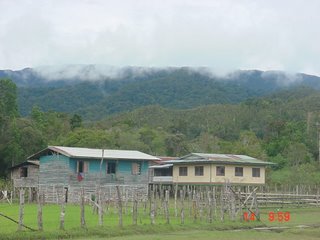


Photograph by Gary Loh Chee Wyai (2006)

The e-Bario project was coordinated by Universiti Malaysia Sarawak and financially supported by the Demonstrator Application Grant Scheme and Canada International Development Research Centre (e-Bario 2004). The project connected the village to the Internet, not only to provide a means for the villagers to communicate with their relatives and others outside Bario, but also "to identify opportunities for such communities to develop socially, culturally and economically from the deployment of the technologies" (Bala et al 2004, p.116).


The researchers realized the importance of engaging and empowering the community, and of placing the emphasis on the people and the process, not the technology. They identified with and learned about life in the village from the community, and the community learned about ICT from the researchers. They adopted a Participatory Action Research (PAR) model, in which community members performed major portions of the research.


In their analysis of the e-Bario project, Bala et al (2004) conclude that a prerequisite for success and sustainability is the use of a collaborative approach in which the community participates fully in all stages and parts of the project. They also suggest that since the information solutions span education, health, commerce, agriculture and culture as well as communications, there is no single agency that carries responsibility or authority for community development by means of ICTs. Instead, a range of agencies needs to be mobilized and coordinated for full benefits to flow to the community (Bala et al 2004, p.124).


Bala, P., Harris, R.W. and Songan, P. (2004) "E Bario project: In search of a methodology to provide access to information communication technologies for rural communities in Malaysia". In Marshall, S., Taylor, W., & Yu, X. (Eds.) (2004) Using Community Informatics to Transform Regions. Idea Group Publishing, London., pp.115-131.


e-Bario. (2004). e-Bario. Website accessed 15 August 2007 at: http://www.unimas.my/ebario/


Wyai, Gary Loh Chee (2006). Bario: the Land of the Kelabits - my third day. Website accessed 19 August 2007 at: http://ebario.blogspot.com/2006/04/my-third-day-at-bario.html

2007-11-18

E-Bario Knowledge Fair: The Kelabit's Gift to Malaysia

Registration for the e-Bario Knowledge Fair, 6-8 December 2007 is now open. This is a unique event, bringing together researchers, practitioners and policy makers with the direct beneficiaries of their deliberations.

The e-Bario Knowledge Fair is a multi-disciplinary conference being held in the remote village of Bario, in the Kelabit Highlands of Sarawak, one of the states of East Malaysia on the island of Borneo. Bario is the traditional home of the Kelabit People, one of Malaysia's smallest indigenous ethnic minority groups. It is also the home of the multi-award winning e-Bario telecentre project that introduced computers, telephones and the internet to this hitherto isolated community.

The Knowledge Fair is being held to showcase how this highly distinctive and resourceful community has appropriated ICTs for their own betterment, on their terms and in a way that is wholly compatible with their long-held and cherished traditions and culture.

Furthermore, the Knowledge Fair is hosting the UNDP Workshop on E-Inclusion and Media for Indigenous Peoples, as a forerunner to a further programme on e-inclusion for Asia’s Indigenous Peoples. The combined outputs of these events are intended to form an important supplement to the recent United Nations Declaration on the Rights of Indigenous Peoples insofar as it relates to the right of access to information and access to ICTs for Indigenous Peoples; especially as two thirds of the world’s Indigenous Peoples live in Asia and almost all live in relatively remote areas with meagre resources.


More on the Kelabit of Sarawak and Malaysia

2007-11-05

Citizen's Voices in Governance


One of the wonderful things about Web 2.0 is that it enables everyone to publish, and hence to have a voice. Here's one way to encourage citizens to have their say:


FixMyStreet is a website that keeps local governments/councils "on the ball" by enabling residents to publicise the problems that affect their neighbourhood. Residents can upload a photographs of the problems, e.g., a broken street light, an abandoned car, rubbish in the street, etc., and specify exactly where the problem is located. The website team informs the relevant council and logs the complaint. The web site publishes a tally of complaints and responses, so everyone can see which councils are responsive and which are not. A bit of "public shame" goes a long way to getting action.


The following video - Citizen's Voices in Local Governance Series - Marketing Culture and Environment: Bohol Investments Promotions Center - shows how local government can assist in cultural maintenance and in providing local employment.


More on local governance.