2013-05-15

ICT for Education Solutions - in Africa, By Africans, for the Global Economy


allAfrica.com:
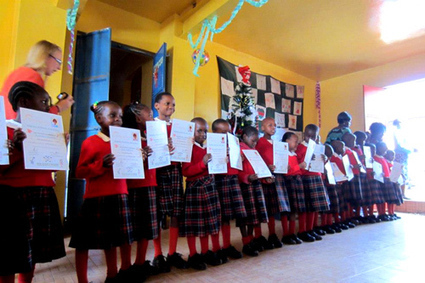
Africa is experiencing a technological surge and it is having a dramatic effect on education throughout the Continent. Tech hubs are blossoming, new mobile devices and apps are being designed and produced in Africa, by Africans, and Africa's eLearning market is now the fastest-growing in the world.

Read more at: http://allafrica.com/stories/201305131819.html


Remote Participation | WSIS Forum 2013


The World Summit on the Information Society (WSIS) Forum has a multi-stakeholder character. The WSIS Stakeholders include governments, civil society, private sector and international organizations from all parts of the world. Today, information and communication technologies (ICTs) provide the opportunity for representation and inclusion of all stakeholders in the WSIS Forum by way of remote participation. In order to ensure participation and inclusion of all WSIS Stakeholders, remote participation has been designed as an integral feature of the WSIS Forum 2013.

Read more at: http://www.itu.int/wsis/implementation/2013/forum/rem_part.html


Kenya Balancing Act: Human Rights, Civil Society, Neo-Colonialism, and Democracy


The drama plays out of whether or not Kenyatta and Ruto will appear in the Hague. The balance between repudiating colonialism and protecting human rights is infinitely tricky. We must get it right.

How can social media change how development is done?


From journalism to business, social media is changing how institutions engage citizens. But what effect will this have on development? Join the debate Thursday, 16 May.

Read more at: http://www.guardian.co.uk/global-development-professionals-network/2013/may/13/social-media-global-development-debate


2013-05-14

About Online Learning


Find out more about online learning or elearning - using audio and video-conferencing, email, chat, and completing an online degree or certificate by distance.

Read more at: http://onlineanddistancelearning.com/about-online-learning


MOOCs and Beyond


In August, 2012, four months after opening, Coursera—one of several Massive Open Online Course (MOOC) providers quickly gaining traction on the Internet—registered one million students, from nearly 200 countries. This is only one of the many staggering statistics that could be shared about the sudden popularity of MOOCs, the total of which speak to the worldwide interest in accessing university courses online.
This issue of eLearning Papers aims to shed light on the way MOOCs affect education institutions and learners. Which teaching and learning strategies can be used to improve the MOOC learning experience? How do MOOCs fit into today's pedagogical landscape; and could they provide a viable model for developing countries?

Read more at: http://www.elearningpapers.eu/en/paper/moocs-and-beyond


2013-05-13

Should university students use Wikipedia?


Most academics look down on the open source encyclopedia, but does it really hinder students' studies?
Despite Wikipedia's drawbacks, students will continue to take advantage of the resource – and the default response of academics to simply advise against using the site is unlikely to have much effect. Lancaster lecturer Dr Catherine Easton says students must develop an ability to analyse the nature of the source material within Wikipedia, adding that the educator should ensure there is "a strong, continuing focus on the need to support academic work with references to acceptable scholarly sources".

Read more at: http://www.guardian.co.uk/education/2013/may/13/should-university-students-use-wikipedia


2013-05-12

Online 'Driver's Ed' Course Preps Kids for the Social Web


As any parent knows, kids aren't naturally inclined to consider the consequences of their impulsive online actions, which can have real repercussions down the line. And in an age where our kids are ever-more connected via the social web, but arguably remain unprepared for the responsibility that come with these connections, one Kickstarter project is looking to help.
"Like driver's ed for the social web," the project website says, "this course will prep tweens for their first Facebook account. With a twist. Parents study, too." It's called HomePage, and it seeks to educate children and parents through an online curriculum that aims to provide both parties with the tools to tackle the social web's most prevalent problems; the snares mentioned, above, as well as academic dishonesty, abusive language and general best practices.

Read more at: http://mashable.com/2013/05/11/social-web-drivers-ed/


2013-05-11

Ken Robinson: How to escape education's death valley


Sir Ken Robinson outlines 3 principles crucial for the human mind to flourish -- and how current education culture works against them. In a funny, stirring talk he tells us how to get out of the educational "death valley" we now face, and how to nurture our youngest generations with a climate of possibility.

See video at: http://youtu.be/wX78iKhInsc


2013-05-10

Take a leadership role with a PhD in Early Childhood Education


This page provides information on PhD early childhood education programs, what is studied in them, where you can study them, the prospects, and more ...

Read more at: http://onlineanddistancelearning.com/phd-early-childhood-education